Eigenvalues and Eigenvectors
An eigenvector is a direction that a square matrix stretches or shrinks without rotating away from itself. The eigenvalue is that stretch factor. They expose natural axes of transformations, covariance matrices, graph Laplacians, and stability dynamics.
Defining math
For , a nonzero vector is an eigenvector when
Here is a square matrix, is a nonzero direction vector, and is the scalar factor applied along that direction. The equation says that applying changes the length and possibly sign of , but not its direction.
The scalar is an eigenvalue, found by solving the determinant equation
This equation is just the eigenvalue equation rewritten into a homogeneous linear system:
The vector is required to be nonzero. Therefore must have a nonzero vector in its null space: it sends at least one direction to zero. A square matrix has a nonzero null-space vector exactly when it is singular, and a square matrix is singular exactly when its determinant is zero. That gives the equivalence:
Geometrically, subtracting means “remove a uniform stretch by from every direction.” If matches a real stretch factor of , then along the matching eigenvector direction the residual map collapses that direction to zero. The determinant detects exactly that collapse.
If is symmetric, its eigenvectors can be chosen orthogonal, giving . This special structure is why covariance eigendecomposition and PCA are stable for symmetric matrices. SVD extends related geometry to rectangular or non-normal matrices by using eigenvectors of .
Worked example
For , solve :
so the eigenvalues are and . Substituting each back into :
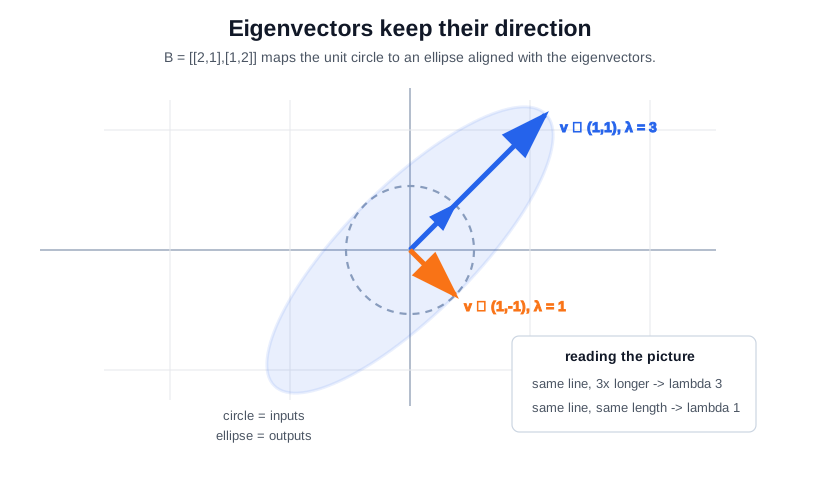
Both satisfy exactly. The larger eigenvalue corresponds to the direction where the matrix amplifies most strongly; along it only scales by .
The plot shows the same result geometrically. A linear map sends the unit circle to an ellipse. Eigenvectors are exactly the directions where the input arrow and output arrow stay on the same line; the eigenvalue is the output length divided by the input length.
Caveats
Eigenvectors are scale-ambiguous: and represent the same direction. Non-symmetric matrices may have complex eigenvalues or too few independent eigenvectors, so do not use eigendecomposition where matrix decompositions such as SVD are the safer tool.
References
Nav