Law of Large Numbers
The law of large numbers says that sample averages stabilize around their expected value. For independent copies with ,
in probability for the weak law, and almost surely for the strong law under standard iid assumptions. This is the consistency mechanism behind statistical estimation. The central limit theorem then describes the remaining fluctuation around the limit.
Intuition
Individual observations remain noisy; averaging divides the cumulative noise by . If the data are representative and the mean exists, positive and negative deviations increasingly cancel. In a random walk, the position may wander, but the average step converges to the step mean.
Worked simulation
This simulation draws Bernoulli trials with probability and prints running means at larger sample sizes to show convergence toward the true probability.
import numpy as np

rng = np.random.default_rng(20260711)
x = rng.binomial(1, 0.37, size=100000)
for n in [10, 100, 1000, 10000, 100000]:
    print(f"n={n} running_mean={x[:n].mean():.5f}")
Observed output:
n=10 running_mean=0.50000
n=100 running_mean=0.41000
n=1000 running_mean=0.35100
n=10000 running_mean=0.36600
n=100000 running_mean=0.36698
The early average is noisy: after 10 draws it is 0.50000, and after 100 draws it is 0.41000. By 100,000 draws the running mean is 0.36698, close to the Bernoulli expectation .
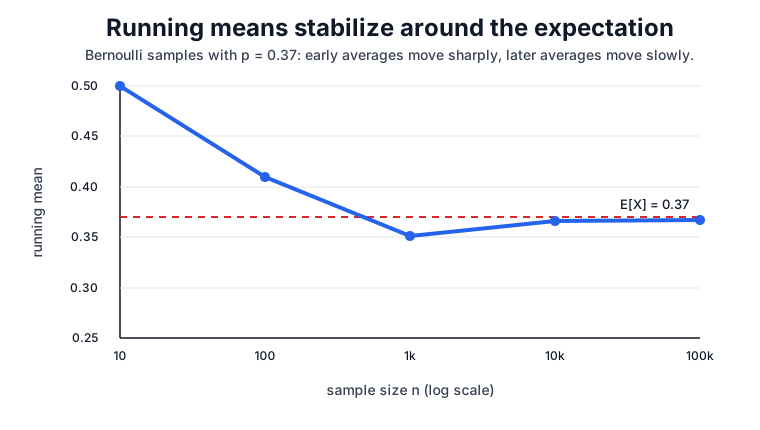
The line is jagged early because a few Bernoulli draws can move the average a lot. Later, each new draw changes by only about , so the curve settles near the expectation line at .
Caveats
More data does not repair a biased sample, changing population, dependence, leakage, or infinite mean. The theorem also does not say every finite prefix is close to the truth.
References
Nav