BM25
BM25 is the default strong baseline for sparse retrieval: it ranks documents by matching query terms, but it does not let one repeated word or one very long document dominate the score. Compared with TF-IDF, BM25 keeps the inverse-document-frequency idea and adds two practical controls: saturating term frequency and length normalization.
The BM25 scoring function
For query and document ,
Here is the term frequency in the document, is document length, and is mean document length. A common IDF variant is
where is corpus size and is the number of documents containing . The parameter controls how quickly repeated occurrences saturate; controls how strongly long documents are discounted. Elasticsearch exposes BM25 with defaults and .
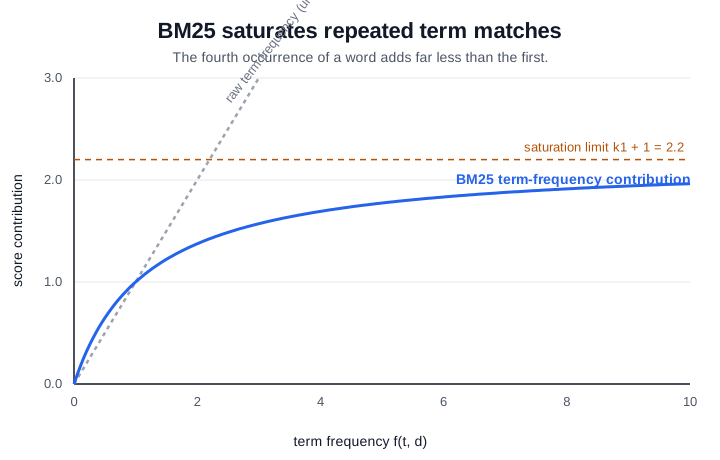
The saturation term is what separates BM25 from raw term counting: the first match of a query word contributes a lot, but each additional occurrence contributes less, approaching a ceiling of . A document that repeats one word a hundred times cannot swamp a document that matches several distinct query terms.
Worked example
This snippet scores a small corpus with BM25, prints document scores, and returns the ranking for a multi-term query.
import math, re
from collections import Counter
import numpy as np

def tok(s):
    return re.findall(r"[a-z0-9]+", s.lower())

docs = [
    "bm25 lexical search handles exact product codes",
    "dense vector search retrieves semantic paraphrases",
    "hybrid search combines bm25 and dense signals",
]
query = tok("bm25 search dense")
tdocs = [tok(d) for d in docs]
N, avgdl, k1, b = len(docs), sum(map(len, tdocs)) / len(docs), 1.2, 0.75
scores = []
for terms in tdocs:
    tf, dl, score = Counter(terms), len(terms), 0.0
    for term in query:
        df = sum(term in d for d in tdocs)
        idf = math.log(1 + (N - df + 0.5) / (df + 0.5))
        f = tf[term]
        score += idf * (f * (k1 + 1) / (f + k1 * (1 - b + b * dl / avgdl)) if f else 0)
    scores.append(score)
print("avgdl", round(avgdl, 3))
print("scores", [(i + 1, round(s, 3)) for i, s in enumerate(scores)])
print("rank", [int(i + 1) for i in np.argsort(scores)[::-1]])
Observed output:
avgdl 6.667
scores [(1, 0.591), (2, 0.629), (3, 1.052)]
rank [3, 2, 1]
Document 3 wins because it contains all three query terms. Document 2 beats document 1 because it matches dense and search, while document 1 matches bm25 and search; the exact numeric gap comes from document frequencies and equal-length normalization.
Where it fits
BM25 depends on inverted indexes because each query term needs a postings list with document IDs, term frequencies, and often field-length statistics. It is hard to beat on identifiers, names, error codes, and rare technical terms. It is weaker on paraphrase, which is why production systems often combine it with dense retrieval through hybrid search or use it as the first stage before reranking.
Caveats
BM25 is a bag-of-words model: it does not understand synonymy, word order beyond optional phrase features, or negation. Tuning and on one query mix can hurt another, especially when fields have very different lengths. Analyzer choices matter as much as the formula; tokenization, stemming, synonyms, and stop-word handling change the postings that BM25 sees.
References
- Manning, Raghavan, and Schuetze, Introduction to Information Retrieval: Okapi BM25
- Robertson and Zaragoza, The Probabilistic Relevance Framework: BM25 and Beyond
- Elasticsearch Reference: Similarity settings
Nav