Sliding Window Inference
Sliding-window inference runs a fixed-size clip model over a long video by choosing window length and stride. It is the practical glue between clip-trained temporal action recognition models and untrimmed streams. The same windows can feed temporal localization, trigger-point prediction, or offline indexing.
Windows and strides
For video length , window size , and stride , windows are
Overlap improves coverage and boundary recall but increases compute. Predictions are then pooled, smoothed, non-max suppressed, or converted into trigger rules depending on the task.
Worked example
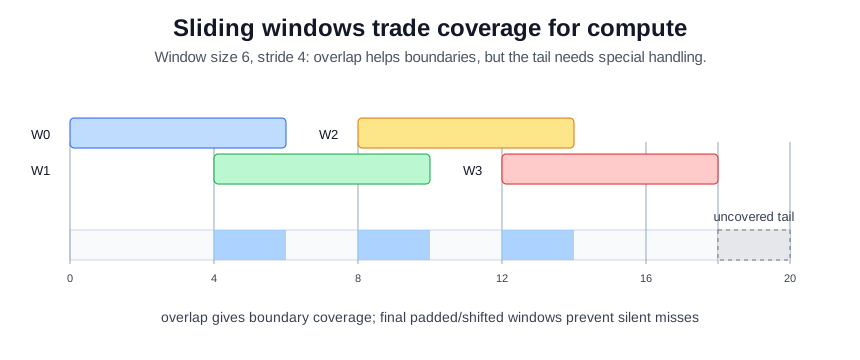
For frames, window size , and stride , the full windows are:
| window | interval | covered frames |
|---|---|---|
| 0, 1, 2, 3, 4, 5 | ||
| 4, 5, 6, 7, 8, 9 | ||
| 8, 9, 10, 11, 12, 13 | ||
| 12, 13, 14, 15, 16, 17 |
Frames 4, 5, 8, 9, 12, and 13 are covered twice because adjacent windows overlap. Frames 18 and 19 are uncovered because the simple full-window schedule stops at frame 18. Production code usually adds a final padded or shifted window so the tail of the stream is not silently missed.
Caveats
Stride determines both cost and worst-case detection delay. Windows split actions at boundaries, so smoothing and non-max suppression must be tuned with tIoU metrics. For real-time video understanding, buffering a full window can dominate latency.
References
- Wang et al., 2016, Temporal Segment Networks
- Wu et al., 2021, Towards High-Quality Temporal Action Detection with Sparse Proposals
Nav