Trigger Point Prediction
Trigger-point prediction decides when enough streaming evidence has arrived to fire an action. It is not retrospective temporal localization: the system must choose now, under uncertainty, with latency and false-trigger costs. Gesture interfaces, safety alerts, and sports-event clipping all need this form of decision.
Thresholding streaming probabilities
For per-frame or per-window probabilities , a threshold trigger is
More careful systems add hysteresis, minimum duration, or cost-sensitive stopping rules. Thresholding is part of real-time video understanding as much as modelling: a lower threshold reduces delay but increases false alarms.
Worked example
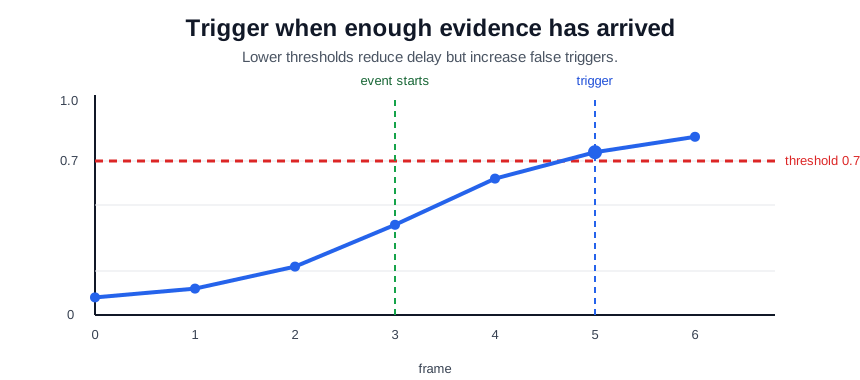
With threshold , the first frame whose streaming probability crosses the threshold is frame 5:
| frame | 0 | 1 | 2 | 3 | 4 | 5 | 6 |
|---|---|---|---|---|---|---|---|
| 0.08 | 0.12 | 0.22 | 0.41 | 0.62 | 0.74 | 0.81 | |
| decision | wait | wait | wait | wait | wait | trigger | already triggered |
If the event began at frame 3, the trigger fires two frames later with . That delay may be acceptable for review queues but too slow for direct manipulation in gesture recognition. A lower threshold would fire earlier, but it would also make ordinary pre-event motion more likely to trigger.
Caveats
Offline metrics can hide early false positives and late true positives. Calibrated probabilities matter because threshold changes are product decisions. Streaming models also face partial observability: early frames may be compatible with multiple future actions.
References
- Assran et al., 2025, V-JEPA 2
- Wu et al., 2021, Towards High-Quality Temporal Action Detection with Sparse Proposals
Nav